The UX Design Challenge is an opportunity for UX Designers to gain practical experience through the process of Design Thinking. An experienced mentor is assigned to a Team of 3-6 to help, encourage and advise through the challenge.
This was an amazing opportunity to apply our knowledge and work together to make something great!
My Role: UX Research & Design
Project: UX Team Design Challenge
Duration: 6 weeks, Mar - Apr 2024
Organizer: IterateUX
Tools used: Figma, ChatGPT/Co-pilot, Google Forms & Meet, Zoom
The Prompt
The Context
A Quote from Business Insider
The Five Stages of Design Thinking

AI
Empathize
About Amazon Prime Video
We learned about Amazon Prime's Video Streaming Service, its revenue sources, and the advertising model in 2024. Understanding these aspects helps us with strategic decision-making and potential implementation.
Description
Video Streaming Service, offered to subscribers of Amazon Prime
Allows users to watch videos and TV shows on demand
Revenue sources
Subscriptions
Advertisements
Digital purchases and rentals
Merchandising
Advertising model
Introduced Ad-supported video-on-demand (AVOD) model in 2024
Users watch advertisements before, during, or after video playback
Service Findings
X-Ray
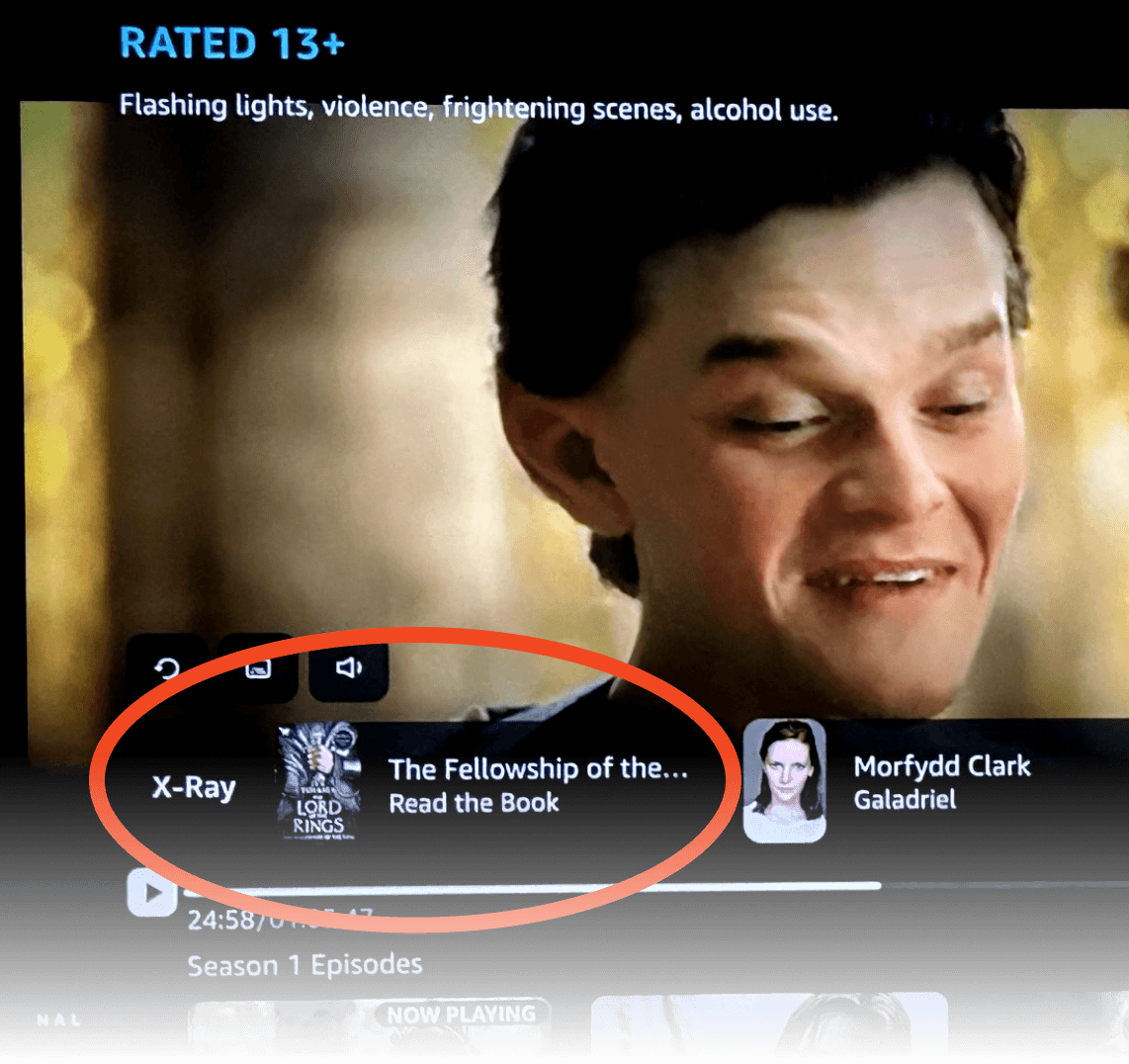
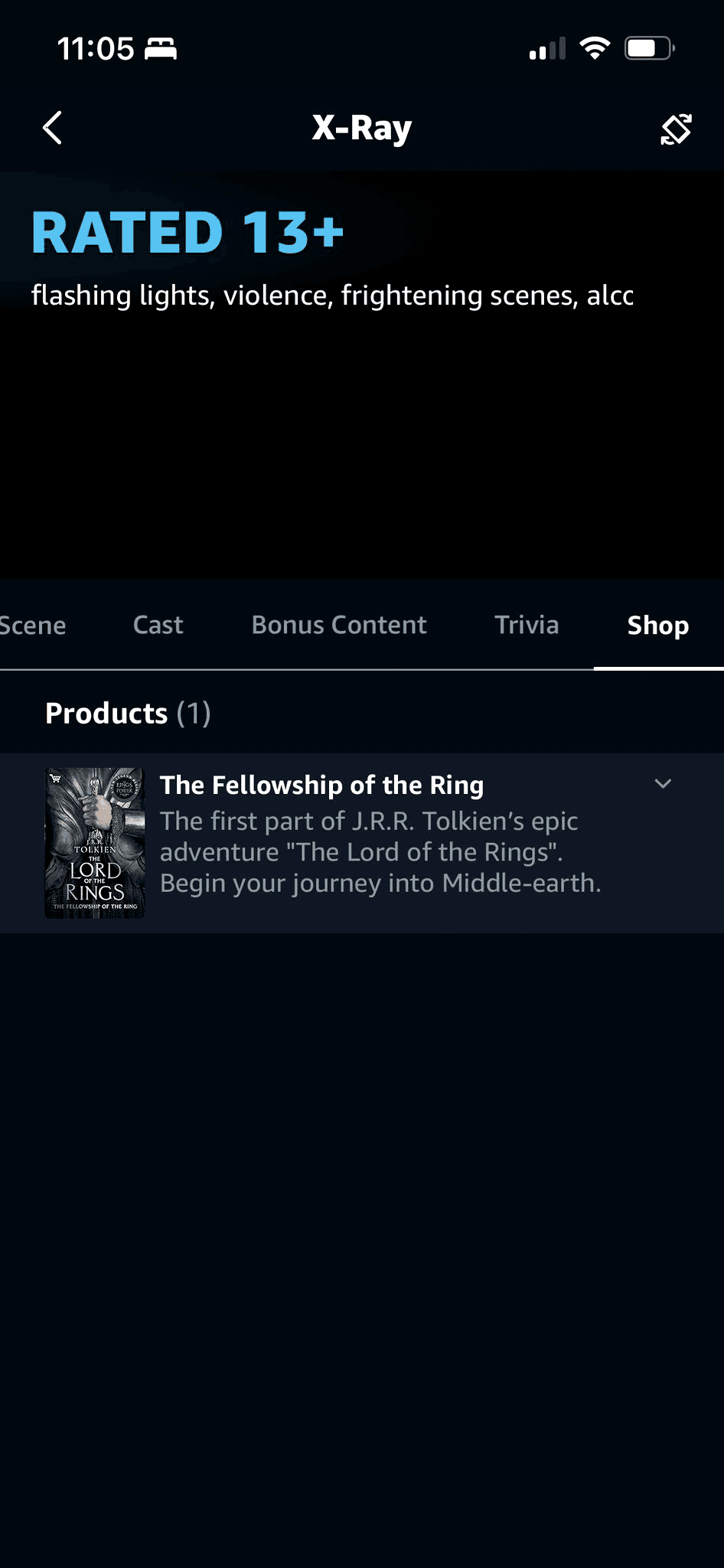
X-Ray is being used to promote products on the TV (left) and the phone (below).
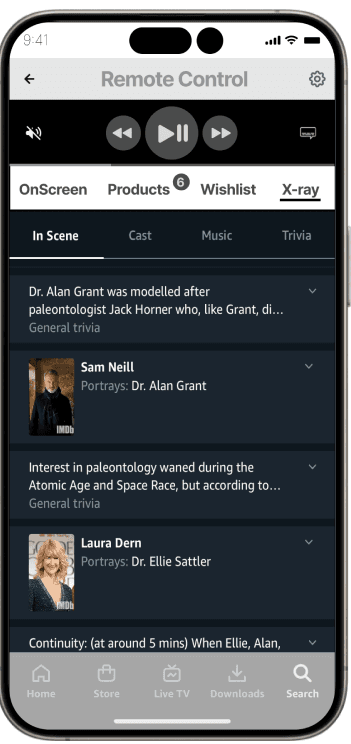
Amazon Prime Video has a feature called X-Ray which integrates facts about a show from the Internet Movie Database (IMDB) which is owned by Amazon. The user can find out information about the show while they watch.
We discovered that X-Ray has been enhanced to offer product suggestions while you watch.
X-Ray feature contains different options depending on the show being watched, and only sometimes products are offered related to the show.
Example: Buy Lord of the Rings books from The Rings of Power
On the TV, the book is listed with the actors when the show is paused.
On a phone in landscape mode the merchandise is listed with the actors, and in portrait you have to scroll far right to see the Shop tab.
Questions raised:
Is this feature used?
Do users know it exists?
Do users find it intuitive?
Can it be improved upon?
Target Audience
SWOT Analysis
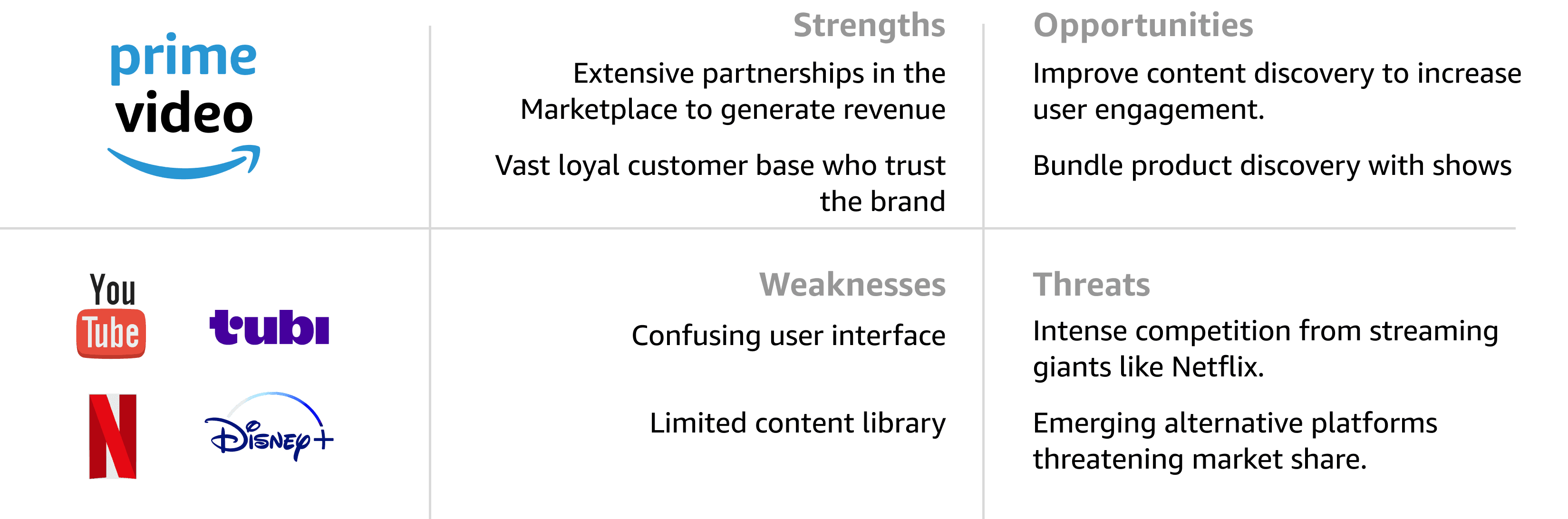
Understanding the strengths and weaknesses, opportunities and strengths, in comparison to the competition will help us identify market gaps.
Value Proposition
Define
User Survey
Knowing that we had a large target audience, we determined that we needed as wide a sample as possible. Surveying the users would give us an indication of which demographic groups within the vast Amazon Prime membership pool were best to design a solution for. We would be able to validate our assumptions, discover their pain points and find common issues they face with Amazon Prime and Prime Video services.
Topics to Explore
Demographics, Frequency of Streaming Usage, Ad Tolerance and Preferences
Participants
26 participants, 10 broad questions, prime members and non-prime members.
Method
We implemented the survey using Google Forms and called for responses from our social media contacts.
Responses
AI
AI Response
“Based on the data you provided, the most frustrating causes of user interruption when viewing shows are:
Ads:
Many users expressed frustration with ads, especially those that can’t be skipped. They felt that these interruptions were wasting their time and were particularly annoyed if the ads were unexpected or poorly timed during the show...”
Qualitative
Quantitative
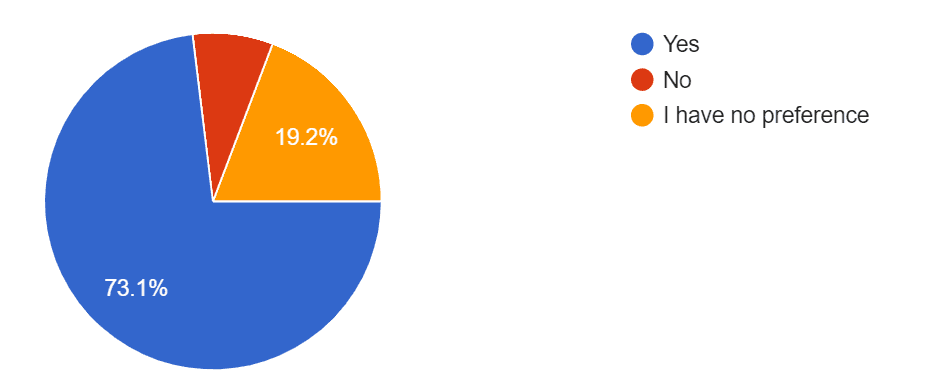
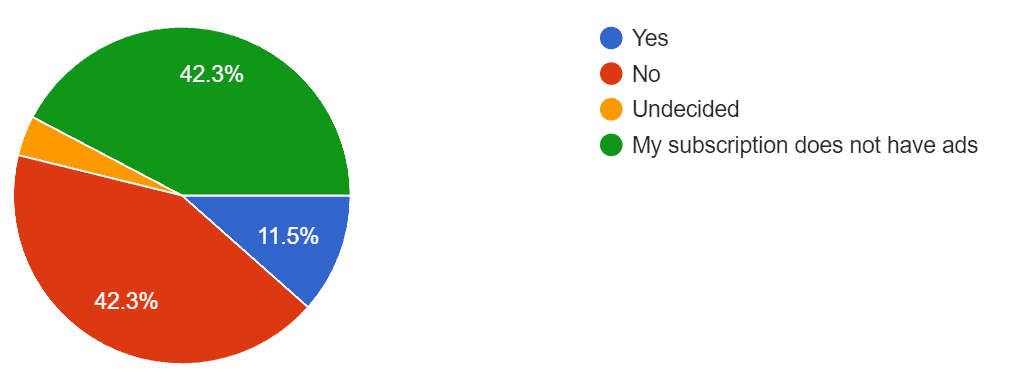
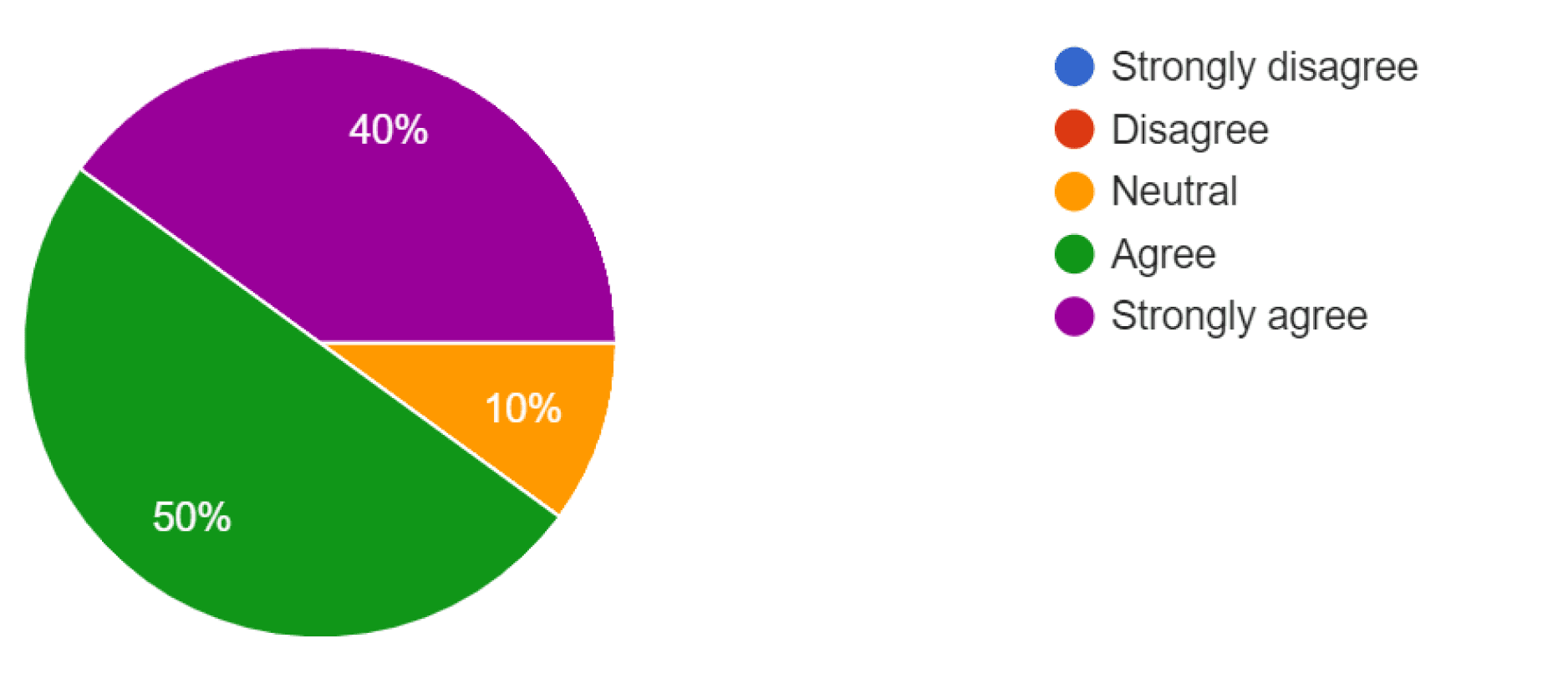
Empathy Map
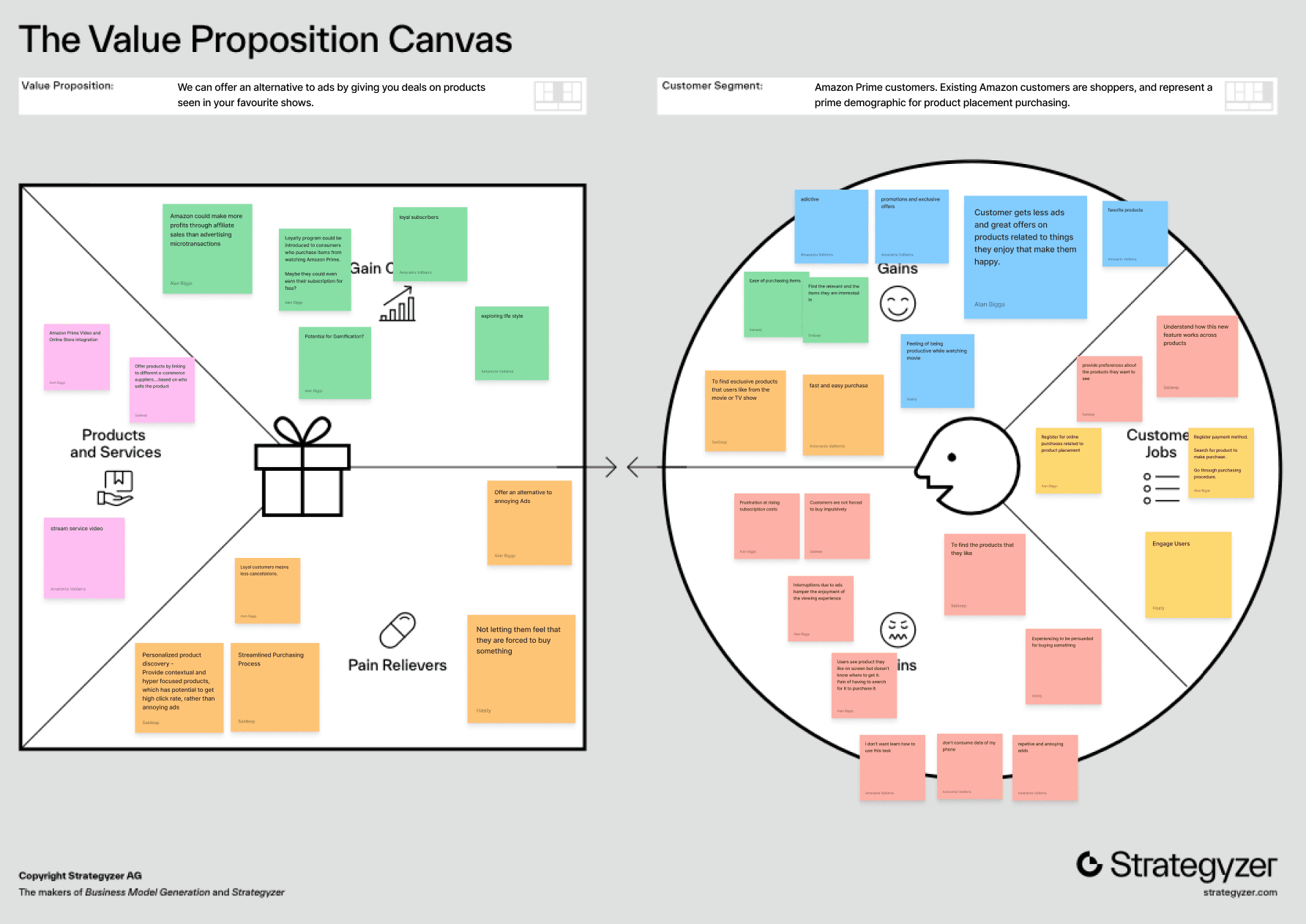
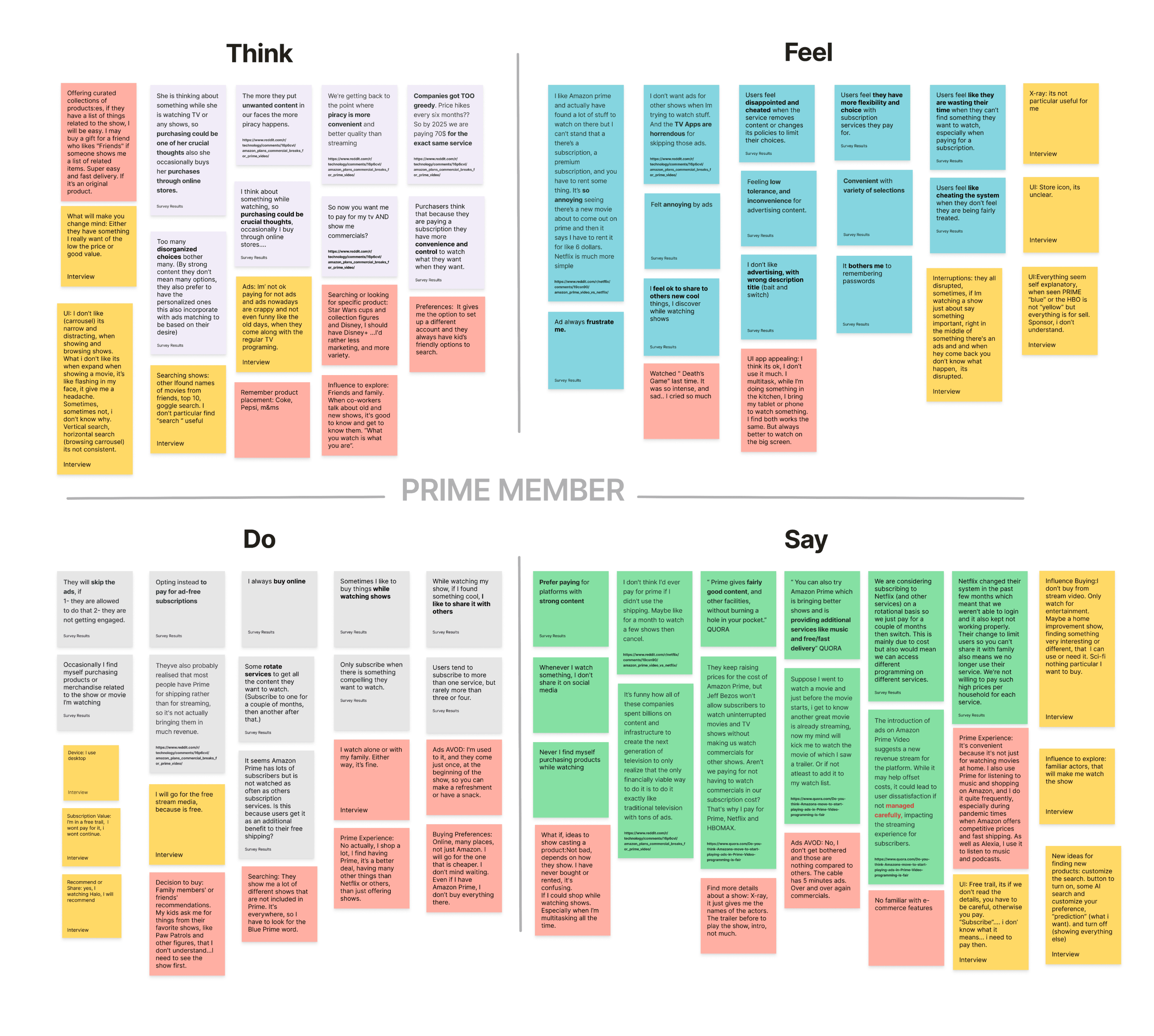
We learned to analyze prime users more deeply through crafting empathy maps, aiding in the creation of personas and target audience understanding. This process helps us better empathize with users' experiences and preferences, guiding our product development efforts more effectively.
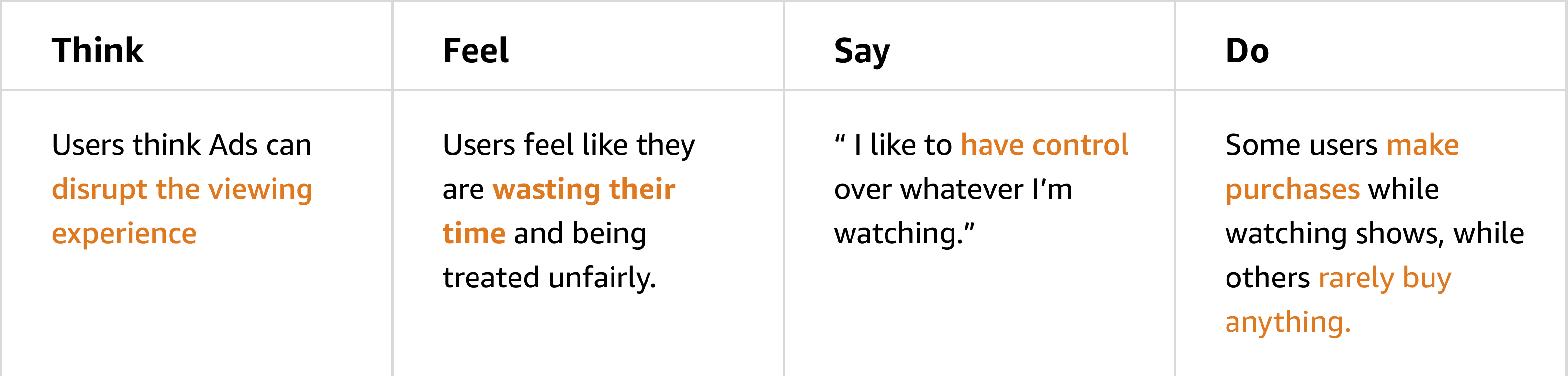
Findings
As we organized our findings of the research we did, from surveys, interviews and secondary research, we grouped similar findings into categories so that we could understand the areas of concern. As we discover new things, we will add them to the map, and may decide to use it in the future to confirm concepts in the Ideation Phase.
Persona Definition
Designing for a global user base
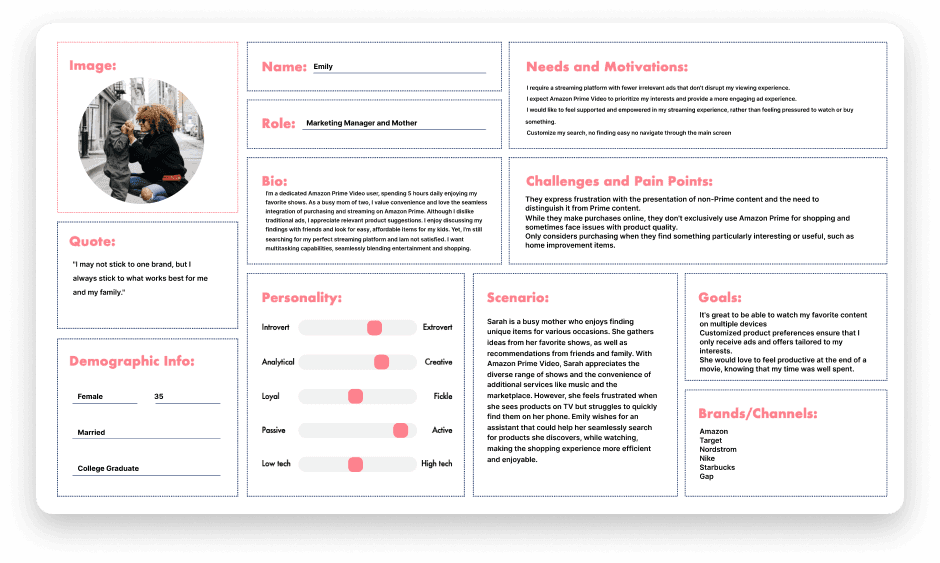
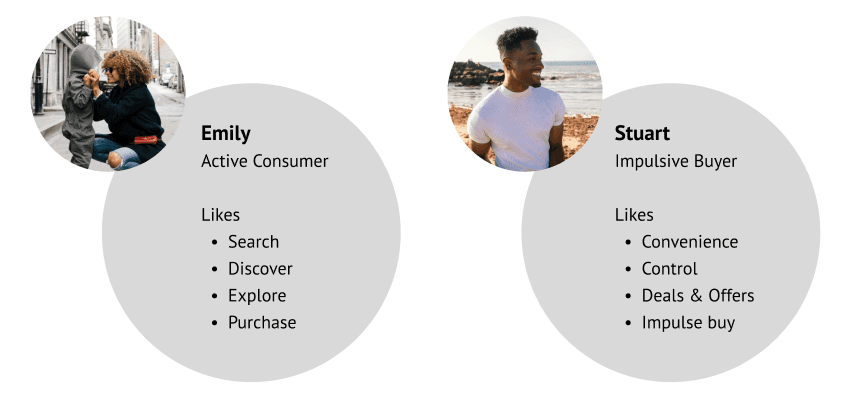
Our Personas:
Emily and Stuart
Meet Emily
Age 35 (Millennial)
Young mother
Concerned about appropriateness of content, especially with children
“I may not stick to one brand, but I always stick to what works best for me and my family.”
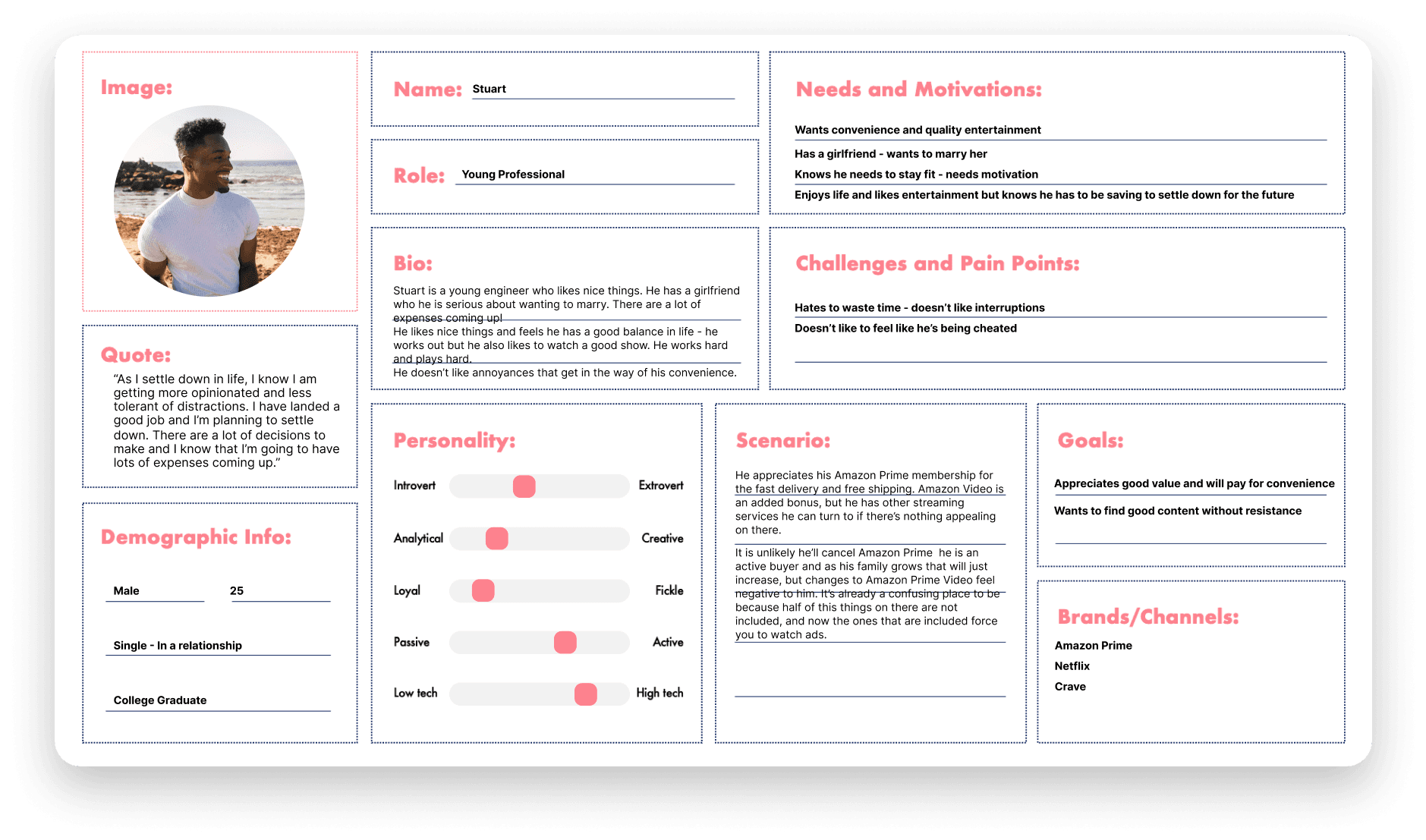
Meet Stuart
Age 25 (GenZ)
Single, Engaged
Likes convenience and control - and nice things
“As I settle down in life, I am less tolerant of distractions. I have landed a good job and I’m planning to settle down. I know I’m going to have lots of expenses coming up.”
Persona Preferences
User Journey
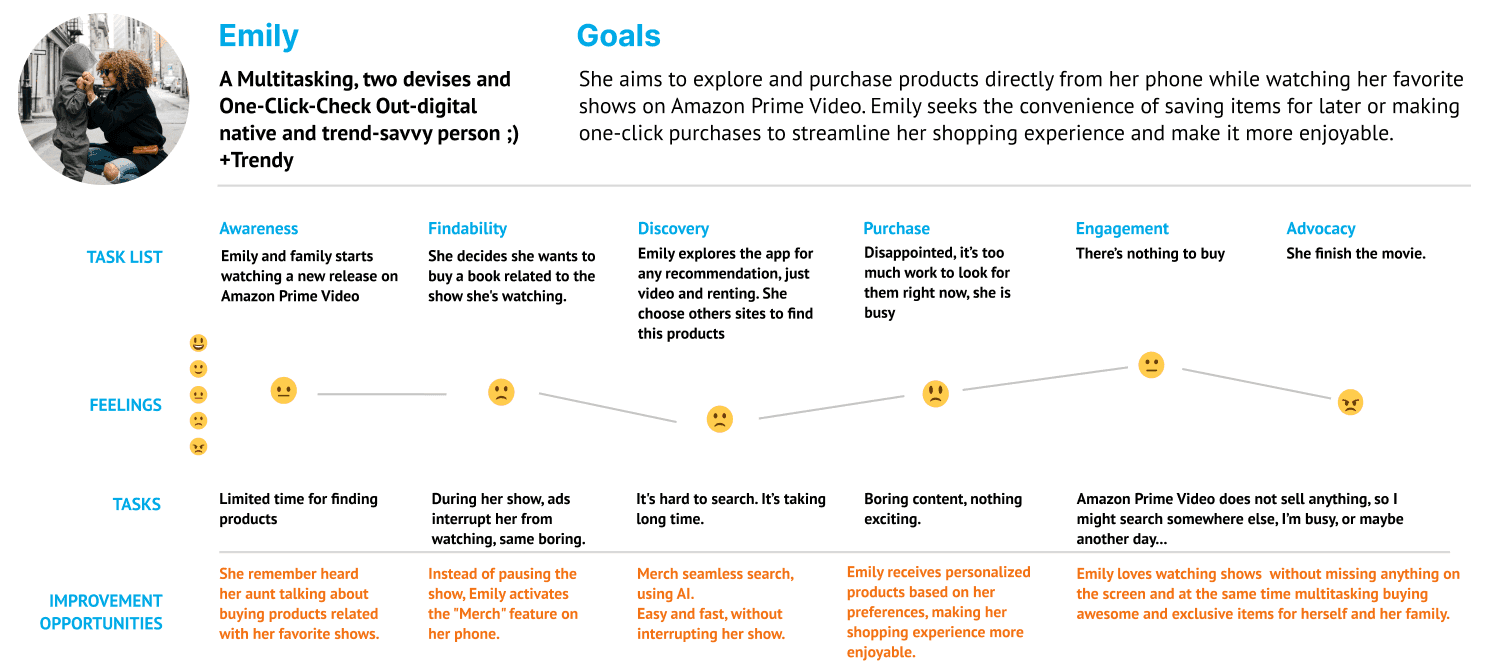
Pain Points
Unwanted interruptions: Full-screen, un-skippable ads are not working for them
Lack of Control: Users pay subscription services for choice and convenience to watch what they want, when they want
Frustration at rising subscription costs without getting any more advantages
Feeling of getting forced to do something which is not their choice
The Problem Statement
How Might We...
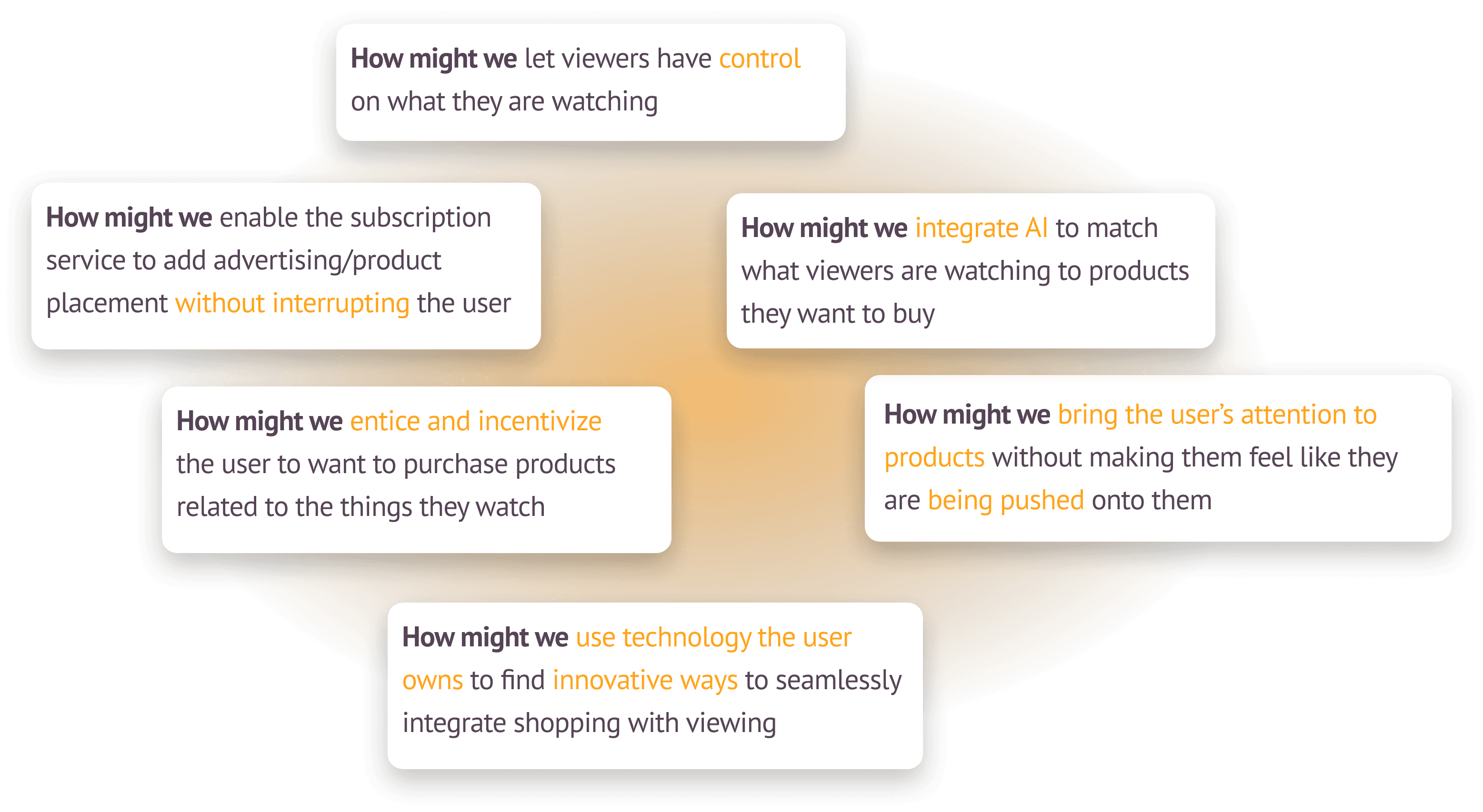
Ideate
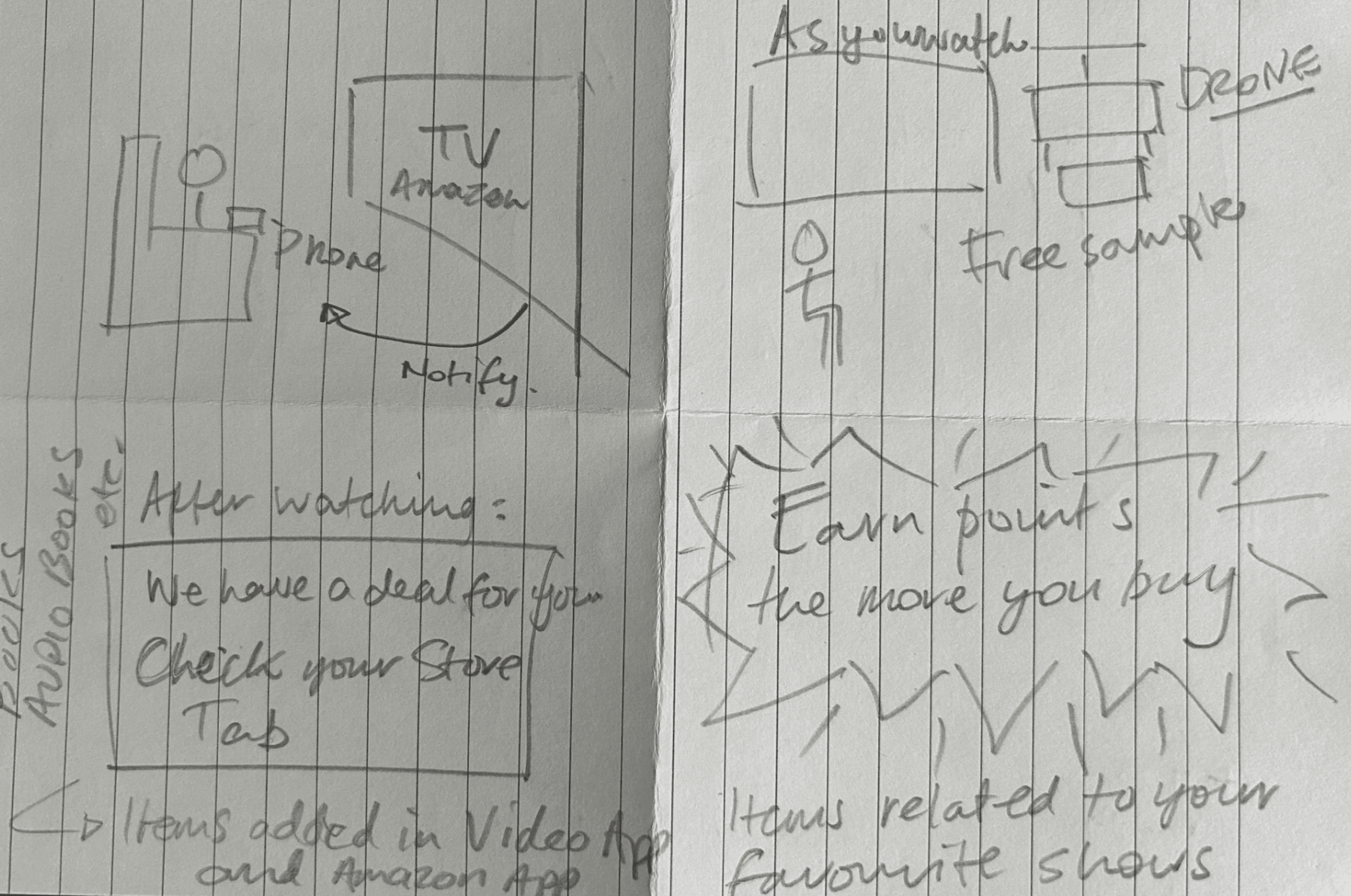
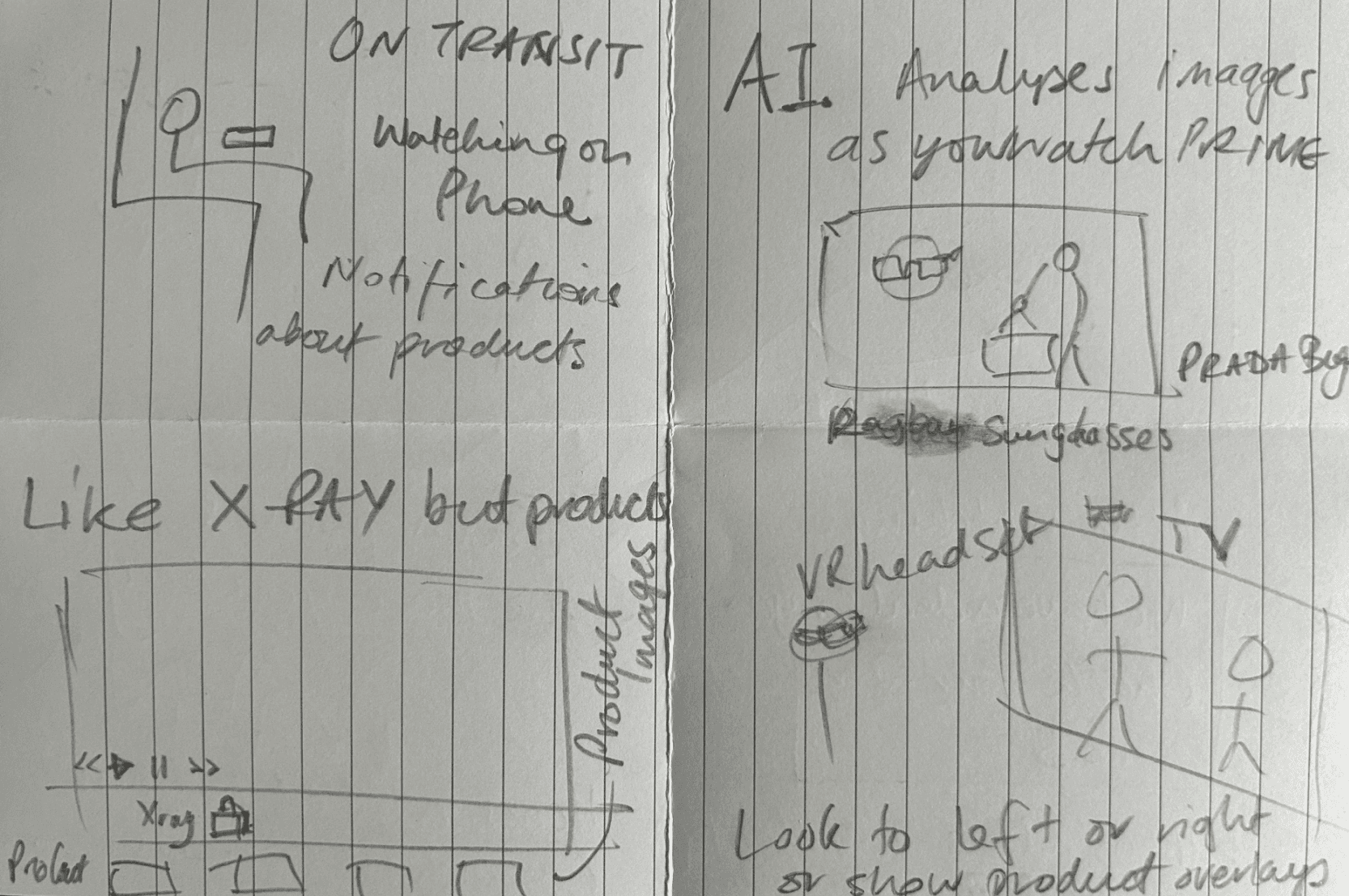
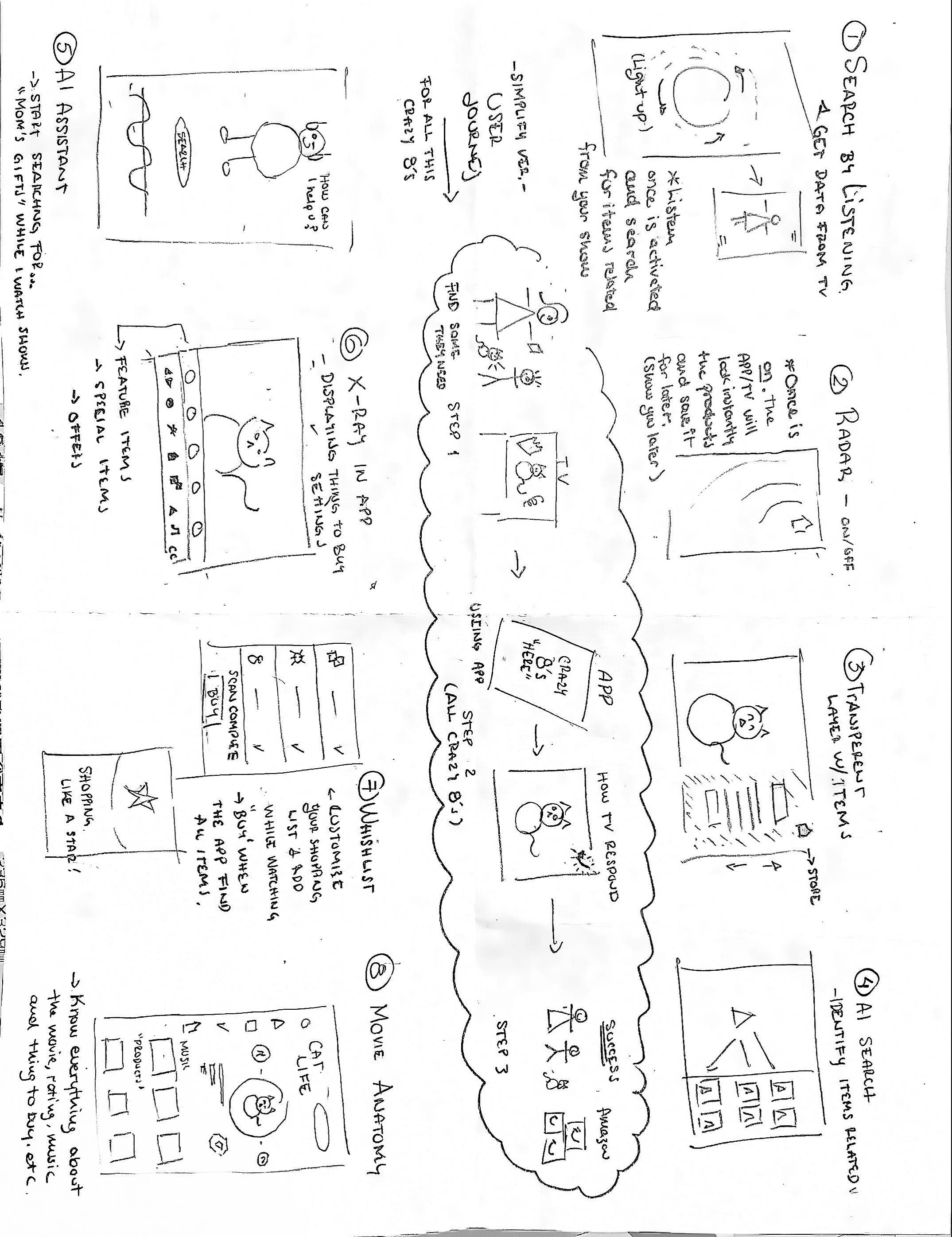
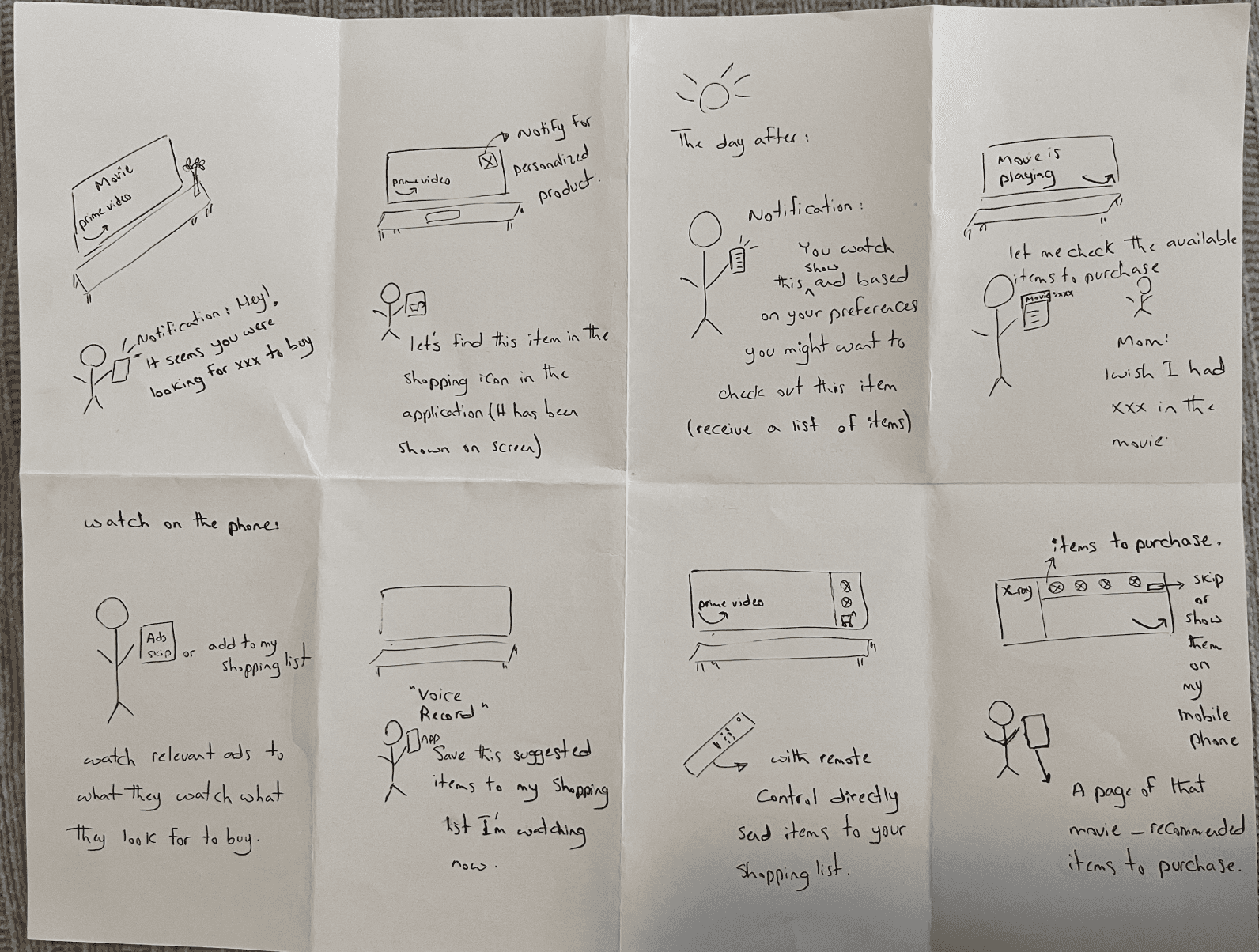
Crazy 8’s
We conducted a Crazy 8’s exercise, sketching 8 ideas in 15 minutes, followed by explanations from each team member.
We identified common themes and listed popular functions, then utilized a voting system to mark the functions best suited to address the Problem Statement with stars.
Using mobile phone to control TV
AI search for products on screen
Points for buying merchandise
Push product suggestions & offers to user after watching show
X-Ray like feature focusing on product placement
VR Headset place ads and products beside the screen
Product notification products based on shows
AI Assitant
Search by listening
Radar
Movie Anatomy
Notified later using AI search
Search with remote control device
Search with voice recognition
Movie anatomy
Features
A companion mode to help users seamlessly find products featured onscreen while watching shows
A new feature to help users find & purchase products instead of pushing ads at the user
Integrated AI image search to find items in the Amazon catalog similar to those seen on screen
Seamless vendor push of related product deal suggestions to the user
Wireframes
Prototype & Test
Usability Test
Through moderated user testing with 8 participants, we analyzed the effectiveness of our two flow prototypes and evaluated the usability of our solutions. We conducted tests to ensure that our new features provide a satisfying user experience, ultimately aiming to validate and improve our design decisions based on user feedback.
Goals
By gaining insights into user interactions and perceptions, the testing aims to ensure a seamless and satisfying user experience.
Participants
8 Amazon Prime Video members
Task
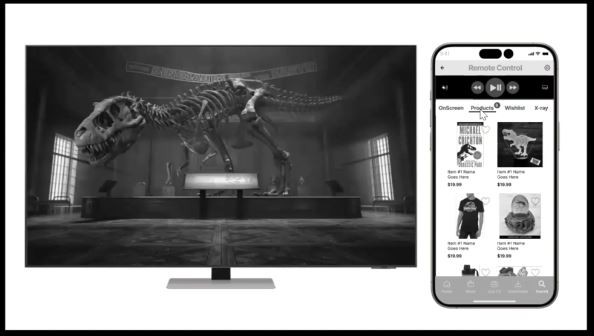
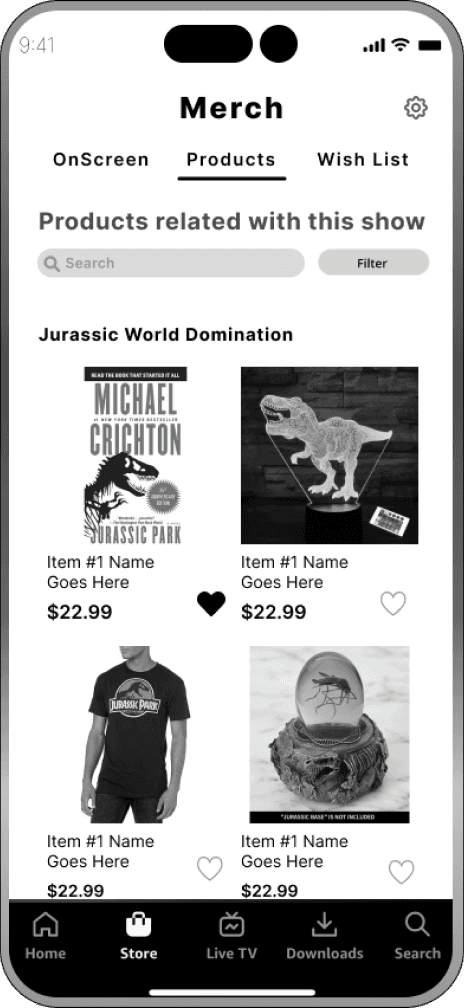
Open the Amazon Prime Video app, and find the new feature called “MERCH” to explore interesting topics and products related to the show.
Explore topics related to the show.
Find a product or item that interests you within the show.
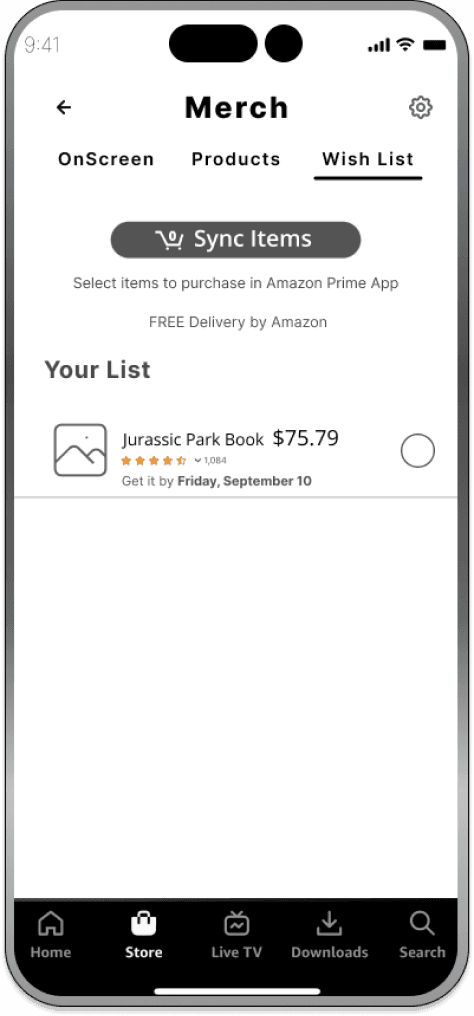
Add the item to your wish list.
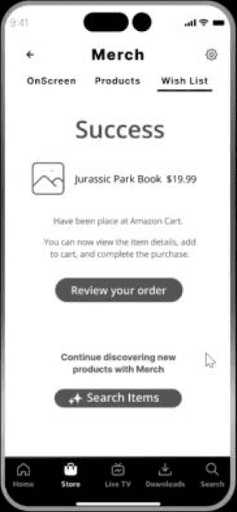
Purchase the product
Usability Feedback
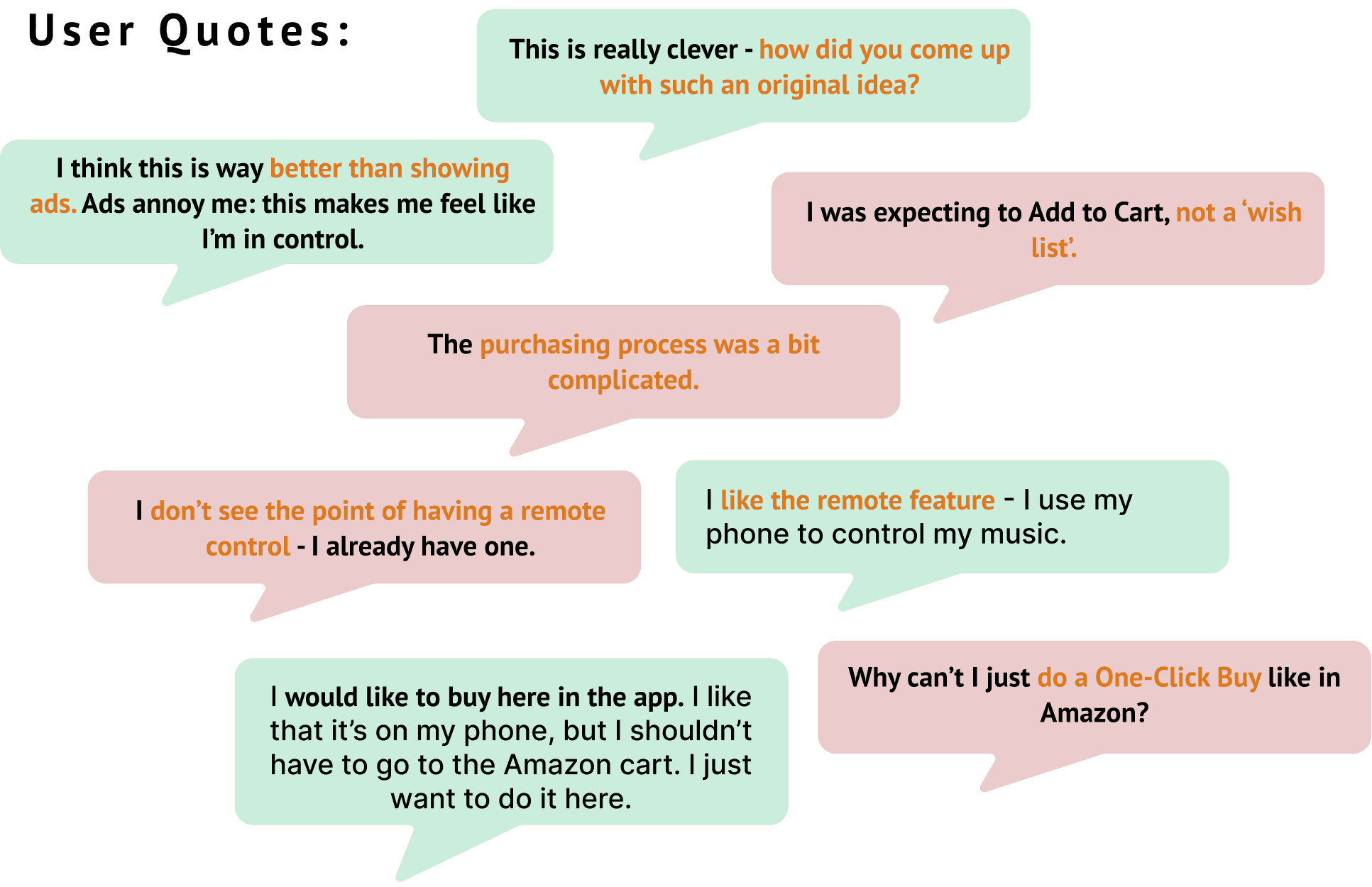
We tracked the metrics of the testing, and also asked questions of the users after each test session.
Success Metrics
Testing identified that the task was not as intuitive as we might have thought. Users found the goal hard to achieve and made assumptions about the interface and the instructions we could not have predicted.
What aspects of the prototype do you think work particularly well, and what areas could be improved?
Is there anything specific that would make you more likely to use the product in the future?
Iteration
Brand Design
We feel that the Amazon Merch brand design is immediately identifiable as part of the Amazon brand family. It is friendly and comforting.
Icon Evolution
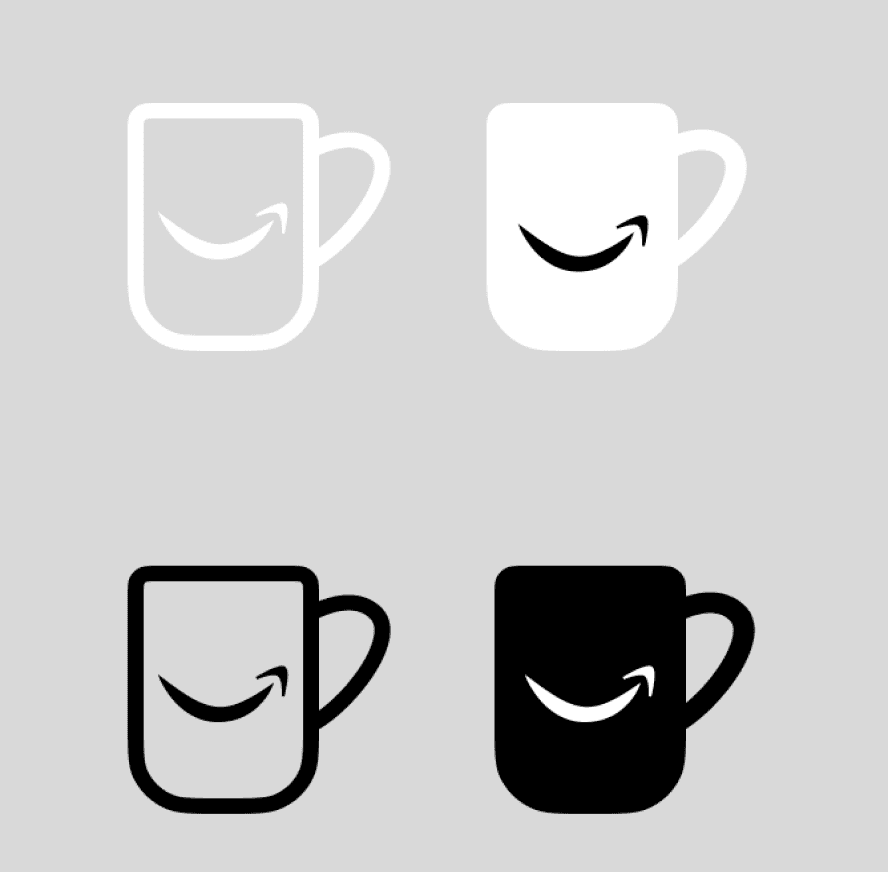
The initial idea for the Merch icon was to create a currency symbol like a dollar sign but using an M. On reflection this started to feel busy and did not scale down well as more elements were included.
We really liked the idea of a mug, as merchandise is stereotypically a branded mug, pen or T-Shirt. The 'a-ha' moment came when adding the Amazon 'swish' arrow to complete the look. It just felt right!
It felt fun, clean, simple and appealing - and it fit right in with the brand.
Design System
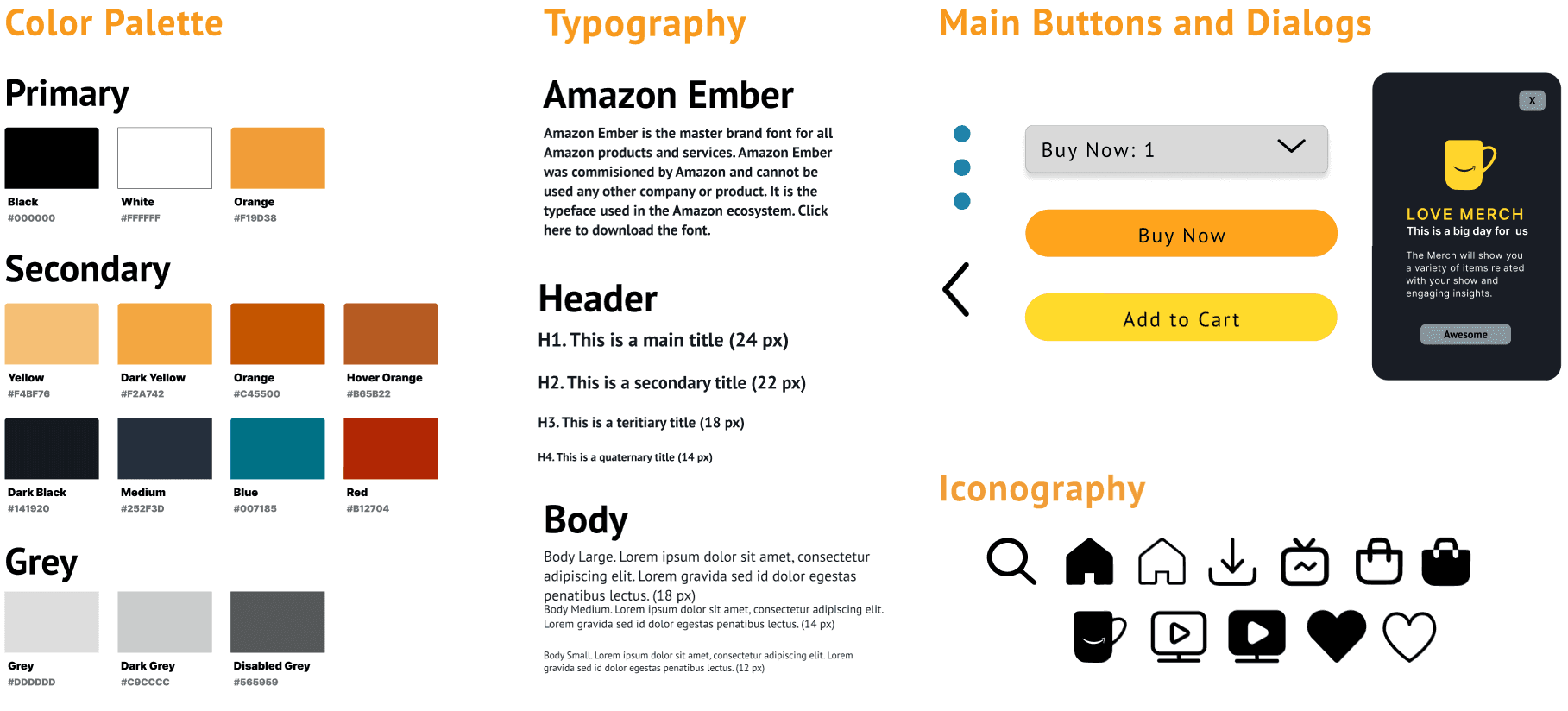
High Fidelity Prototype
Interface Design Commentary
The design of the app was intended to work to serve two user scenarios:
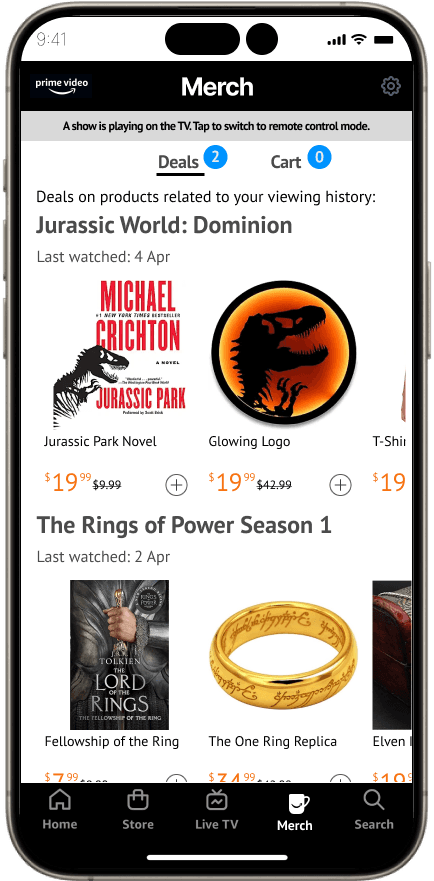
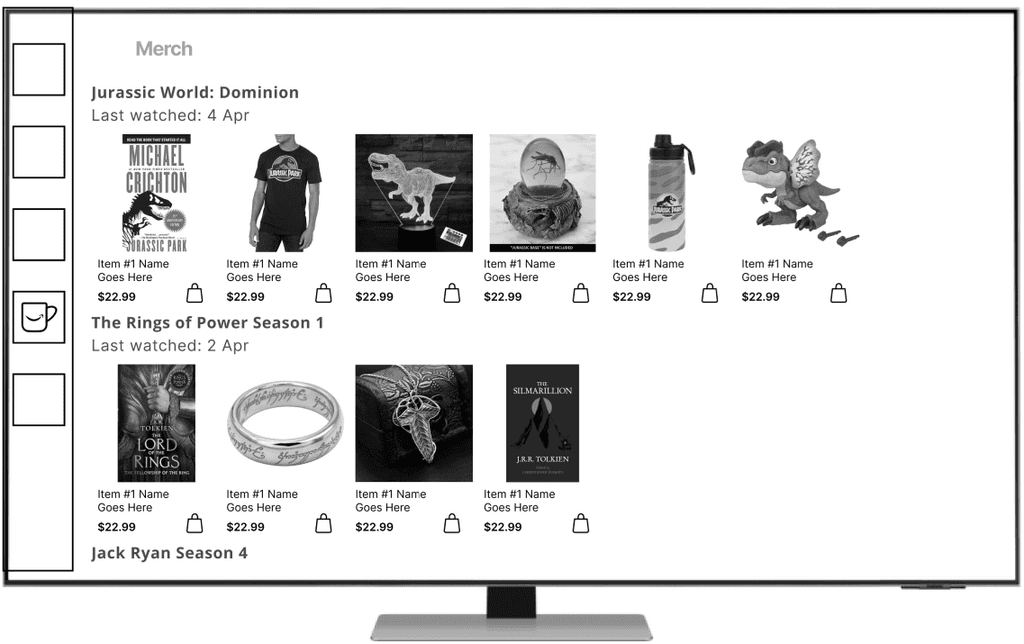
When browsing their viewing history for suggested products related to the shows they have watched
Simultaneously when watching a show on the Prime TV app
Merch Feature mode
The Store in Amazon Prime Video is designed to purchase streaming content. Since we are introducing a new feature, we feel it is important to have it dominant in the interface, so it is proposed that the Downloads section is replaced by Merch. Merch shows the user's viewing history and associated merchandise. Product sponsors can push deals to the user, including product placement items.
We discovered that users often want to go back to what they were watching, and cognitively remember what they were watching recently.
"Remember that show we watched last week - did we watch the last episode?"
"Perhaps I can get gift ideas for my daughter based on that show she was watching?"
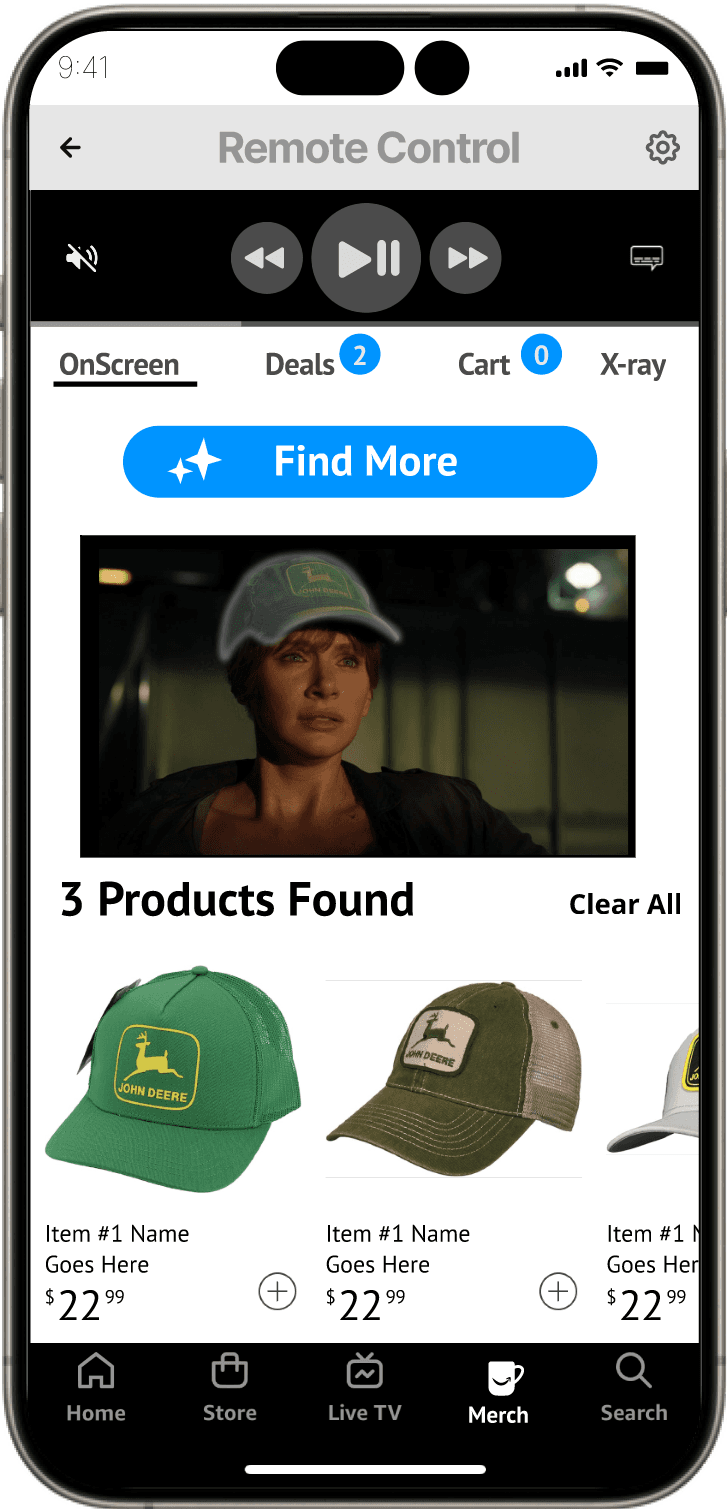
Remote Control mode
The main theme of Merch is to bring attention to related products. How might we make the feature appeal to the end user?
Using our findings that users, like Stuart, want control, we introduced a Remote Control mode within the Merch tab.
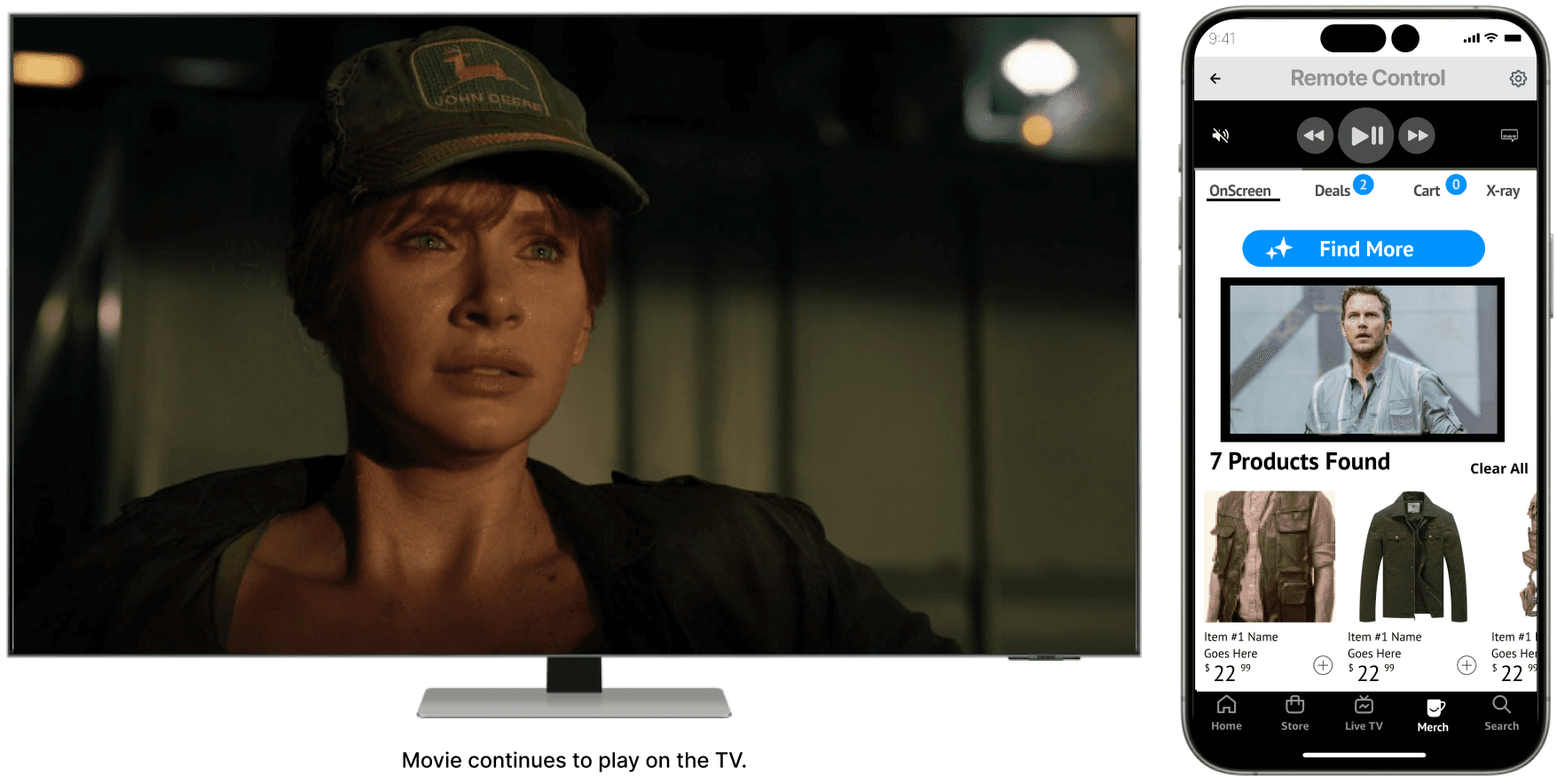
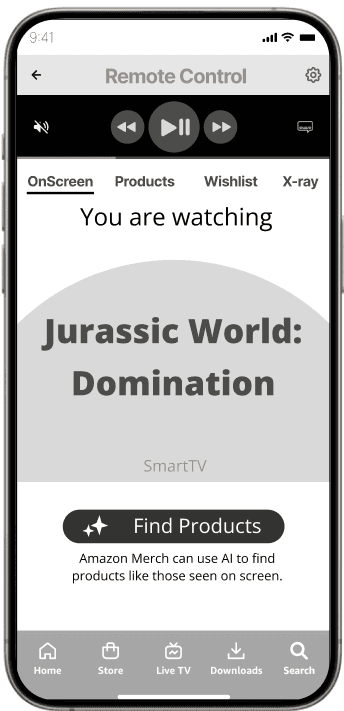
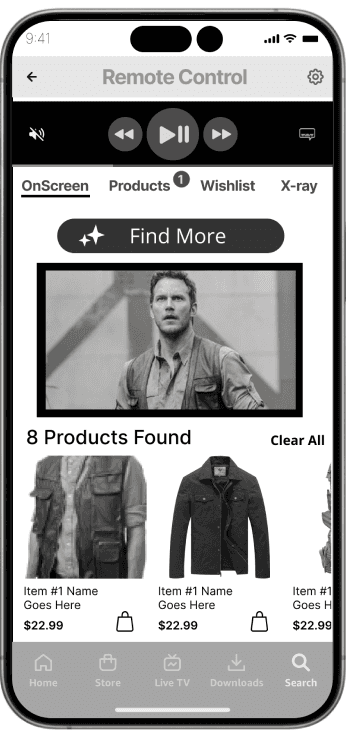
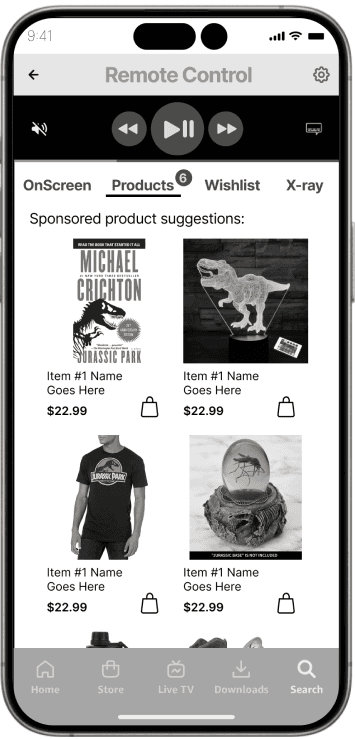
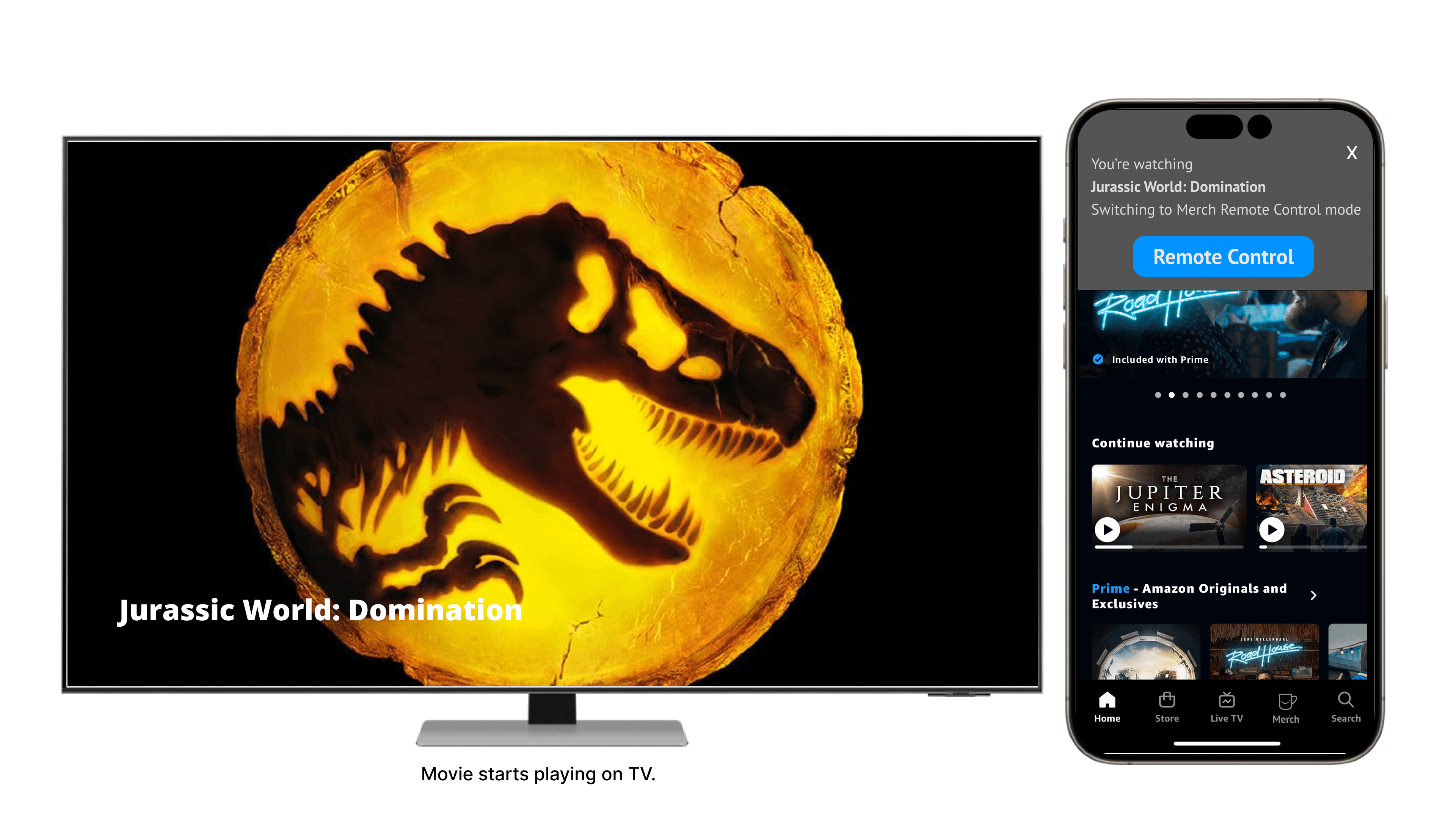
When a user starts watching a show on TV, the app detects this and offers to switch the user to Remote Control mode. In this mode, two extra tabs appear, OnScreen and X-Ray, plus remote playback controls, with which the user can control the playback, mute sound and turn captions on and off.
Live X-Ray features here make much more sense when part of a remote companion mode on a mobile phone.
The user can use an AI image search to identify products on screen, including any intentional product placements by sponsors. Once objects are identified, similar products are found in the Amazon store catalog.
Traditional wisdom might determine that the control buttons should be placed near the bottom within 'thumb reach', but placing them at the top is intentional:
a user with control does not want to accidentally interrupt the movie in a group setting.
the primary intent is for the user to browse and purchase related merchandise during the show. The main activity of the design is product discovery, not playback control. Having to reach over the playback controls could very well be problematic.
Reflection
On reflection we realized the incredible potential of what we had created, and the great potential for a more human centered product promotion model than traditional advertising.
Learnings
Different classes of user have different expectations of technology:
Some are completely comfortable with an integrated experience
Some use one device at a time for a specific purpose
Some (typical younger generations) multi-task and have several devices at their fingertips
Users get frustrated if the technology does not allow them to recall past experiences
Next Steps
With so many directions we could go in and features we could explore, we would
Determine which features are worth pursuing by doing extensive user research to determine what appeals to whom
Refine features and integrate them more smoothly into the prototype
Do extensive user testing and get detailed feedback